
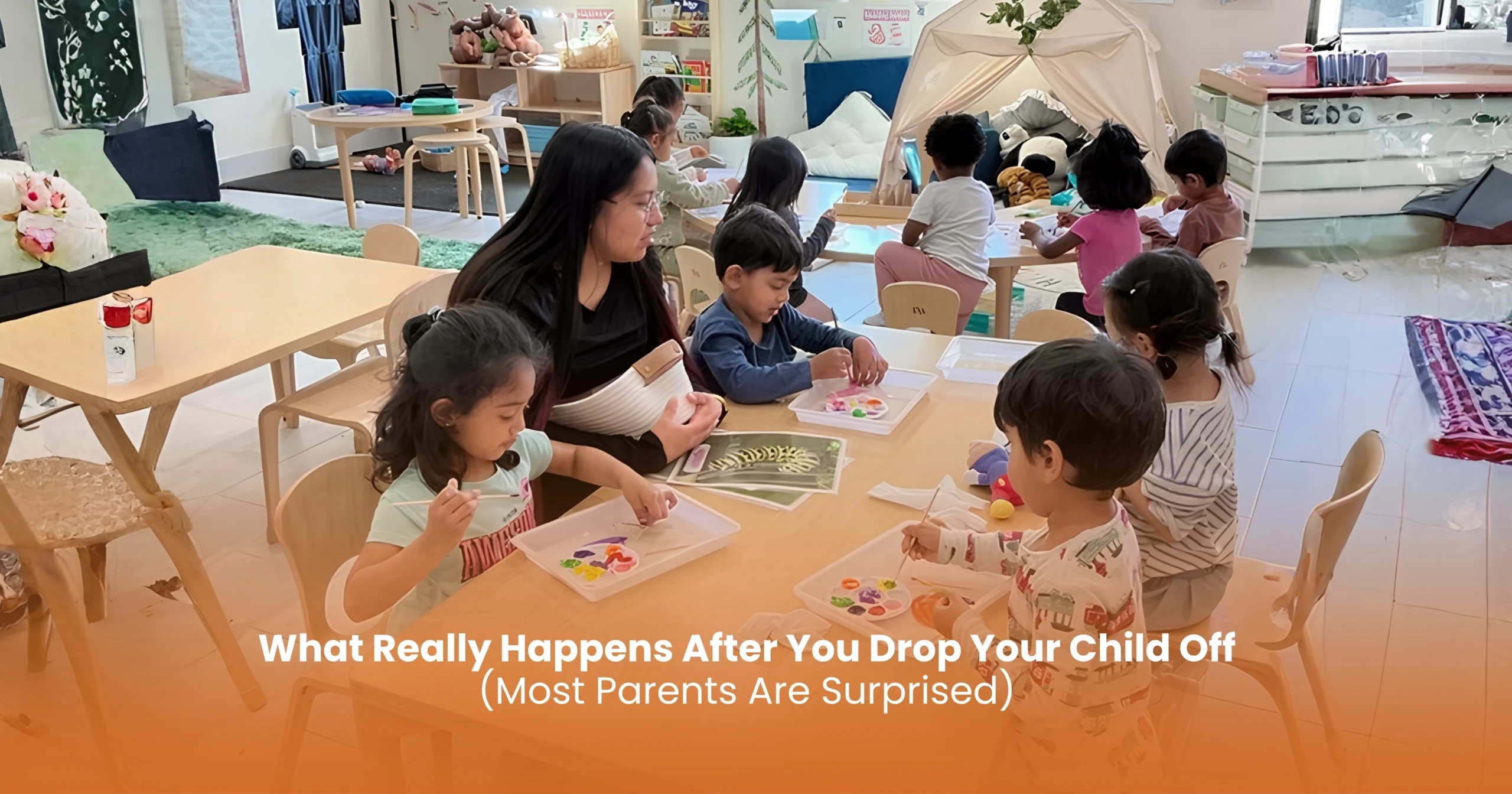
What Really Happens After You Drop Your Child Off (Most Parents Are Surprised)
The drive home is quiet in a way that feels strange.
You just handed over the most important person in your world to a building full of people you’re still getting to know. You smiled, said goodbye, maybe held it together until you got to the car. And now you’re at a red light wondering: what is she doing right now? Is he okay? Does anyone notice if he’s having a hard morning?
Every parent who has ever enrolled a child in preschool knows this feeling. It doesn’t mean you made the wrong choice. It means you’re paying attention. So let’s actually answer the question. Here’s what a day at Milestones Academy of Texas looks like after you pull out of the parking lot.
7:30 AM – They’re Greeted by Someone Who Actually Knows Them.
There’s a window right after drop-off that sets the tone for a child’s entire day. A child who transitions badly, who stands at the door watching you leave without anyone noticing, carries that unsettled feeling into every activity that follows. A child who is greeted by someone who genuinely knows them settles in faster, eats better, and participates more.
At Milestones, every child is assigned a Key Person: a specific teacher who serves as their primary relationship inside the school. This comes from the Early Years Foundation Stage (EYFS) framework the school follows, and it isn’t just an administrative label. The Key Person knows your child. They know whether your child needs five quiet minutes before they’re ready to join a group or whether they come in looking for their best friend immediately. They notice when something seems off before your child has the words to explain it.
For children who are still adjusting to being away from home, this consistency is what makes the difference between a child who tolerates preschool and a child who genuinely wants to go. Parents who expected a more impersonal experience tend to notice the Key Person arrangement within the first week. It changes the feeling of drop-off for the child and the parent both.
8:00 AM – The Day Begins.
Young children do better when they know what comes next. Not because they’re rigid, but because predictability is what allows them to take risks. A child who trusts that outdoor time follows STEM, and STEM follows storytime, has mental energy left over to try the harder puzzle or start a conversation with someone new.
The morning opens with circle time: greetings, songs, the day’s theme, a conversation about what they’ll be doing together. For children who are still building language or social confidence, the predictable rhythm of circle time is one of the most important parts of the preschool daily schedule. It tells them: you belong here, this is your group, today is going to make sense.
From there, the morning moves through structured blocks. Storytime is built around language development, not just reading aloud, but asking questions, building vocabulary, connecting what’s in a book to what a child already knows. STEM activities are hands-on and age-appropriate, which at this age means building, sorting, measuring, observing, making predictions and being surprised when they’re wrong. Creative arts include music, movement, painting, and open-ended making.
And then there’s yoga, which surprises most parents the first time they hear it. But there’s a practical reason it’s in the schedule. Three and four year olds have a lot of sensory input arriving at once in a school setting. Short yoga sessions teach children to notice how their body feels and to calm it deliberately. The children take to it faster than most adults would expect.
10:00 AM – Someone Is Paying Attention to Your Child.
One of the quieter anxieties parents carry, the one they don’t always say out loud, is whether their individual child is actually seen inside a group setting. It’s easy to imagine a classroom where the loudest children get the most attention, and the quieter or more uncertain ones drift through the day without anyone really registering them.
The Key Person model is designed specifically to prevent that. Each teacher tracks the development and daily experience of the children assigned to them, not in a clinical way, but in the way that someone who genuinely knows a child pays attention. If your daughter hasn’t eaten well for three days, her Key Person notices. If your son suddenly goes quiet during outdoor play after weeks of being social, someone sees it.
Teachers at Milestones are trained to meet each child at their current level and work from there. A child who is already recognizing letters gets gently stretched. A child who is still warming up to group activities gets low-pressure opportunities for connection, not forced participation, but gradual encouragement toward it. The goal isn’t to move every child along at the same pace. It’s to move each child forward from wherever they actually are.
11:30 AM – Lunch That Someone Cooked For Them Specifically.
At a lot of childcare centers, lunch is a logistical problem to be solved. Food arrives in bulk, gets heated, and gets distributed. It’s adequate, and no one thinks too much about it.
At Milestones, lunch is prepared fresh each day by an on-site chef. The ingredients are non-GMO and organic. Dietary restrictions and food intolerances are accommodated as part of how meals are planned, not treated as a complication. This is included in tuition.
The reason it matters isn’t only nutritional, though that matters too. Mealtimes are part of the school day in a real sense. Children practice independence: serving themselves, cleaning up, having conversations across a table. The quality of the food signals something to children, even young ones: you’re worth the effort. That’s not a small thing when you’re three years old and away from home for the first time.
1:00 PM – It’s Quieter. Perfect For Rest.
After lunch, the pace shifts. Younger children rest. Older children move into quieter individual activities like puzzles, books, and fine motor work that let them consolidate the morning without the same level of social effort.
The afternoon is also when language learning happens. Milestones offers Spanish and Mandarin to all children, starting in infancy, taught through songs, rhymes, stories, and simple phrases woven into natural activity. Children at this age absorb language through repetition and context, and the teachers plan sessions with that in mind, working with how young children actually learn, not how adults assume they should.
Parents often mention that the language exposure shows up at home without warning. A child counting in Spanish at the dinner table. A Mandarin word appearing in the middle of an otherwise ordinary sentence. It tends to happen before parents realize it’s happening, which is exactly how it’s supposed to work.
3:00 PM – You Don’t Need To Guess What’s Up.
Just talk to us to see what’s going on with your child. One of the harder parts of sending a child to preschool is the gap between drop-off and pickup. You don’t know if the morning went well. You don’t know if they ate. You don’t know if something happened with a friend that they won’t have words to explain until next week.
Teachers at Milestones update parents throughout the day through Procare, an app that sends notes, photos, and observations in real time. When something good happens, a child finally conquering the climbing structure they’d been nervous about, or a moment of genuine kindness toward another child, you see it the same day. And if something is off, you hear about it before pickup rather than piecing it together from a tired five-year-old’s account at bedtime.
For parents who want an additional layer of reassurance, enrolled families also have access to CCTV footage during the school day. The school makes this available because the owners understand that trust between a family and a preschool isn’t given automatically. It’s built, slowly, through consistency and transparency.
What the First Month Usually Looks Like
The adjustment period is real. Some children settle in within days. Others need a few weeks before drop-off stops being hard. Neither is a sign that something is wrong.
What parents tend to report after the first month falls into a few consistent patterns.
The most common is this: the child who cried at the door on day three is, by week six, frustrated on weekends that school is closed. That shift happens when a child feels genuinely safe with the people caring for them, and genuinely engaged by what they’re doing each day. It can’t be manufactured, and it shows up reliably when the environment is right.
The second is specific, observable learning appearing at home. Letter recognition, number sense, the ability to wait their turn during a game, the habit of asking questions about how things work. Parents of children picking up Spanish and Mandarin phrases describe a particular kind of surprise: they expected language learning to be slow and formal, and instead their child just starts using words.
The third is harder to name but tends to be what stays with parents longest. It’s the way their child talks about their teacher. Not “my teacher” as a generic role, but by name, with specific detail about what she said, what she did, what made them laugh that day. That specificity is the Key Person relationship working the way it’s meant to. Your child is known by someone at that school. Not as a student in a classroom, but as a specific person whose particular way of being in the world matters to the adult responsible for them.
That’s what most parents are surprised by. Not the curriculum or the food or the schedule, though those matter. It’s the realization, somewhere around the end of the first month, that their child is genuinely okay there. More than okay.
If You’re Still Deciding Whether Milestones Academy is Right For Your Child
Choosing a preschool involves more uncertainty than most parenting decisions. You’re making a judgment call about people and an environment based on limited information, at a stage when your child can’t fully tell you what their experience is like. That’s a legitimate difficulty, and no amount of reading about a school fully resolves it.
The most useful next step is to come in while the school is actually running: a weekday morning, when the children are there and the day is moving. That’s the version of Milestones worth seeing.
Related reading: All Programs · Our Teaching Philosophy
See Milestones Academy in Person
Visit our Lewisville campus, meet the educators, and ask the questions that matter to your family.