
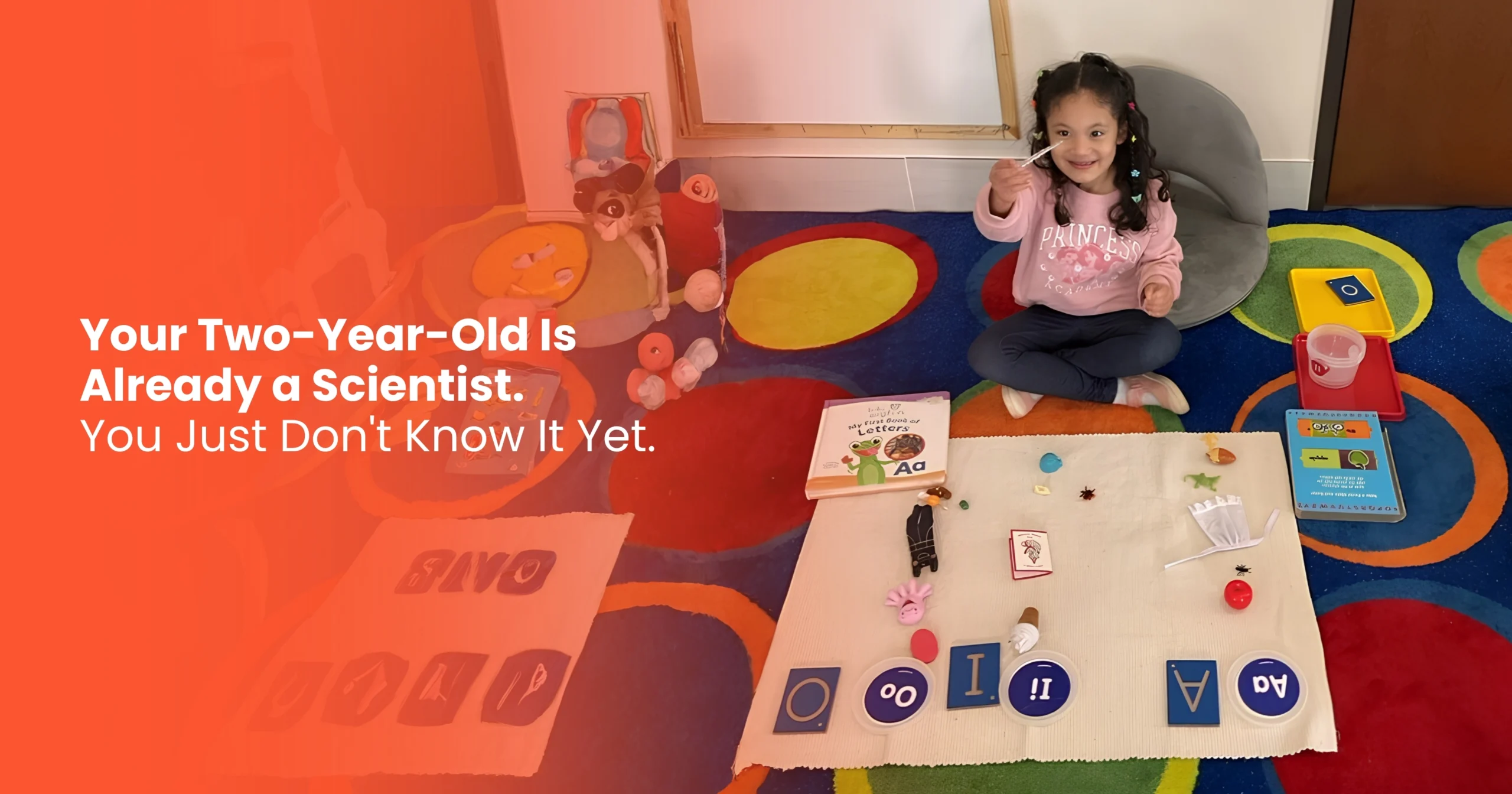
Your Two-Year-Old Is Already a Scientist. You Just Don’t Know It Yet.
Watch a two-year-old at the dinner table for five minutes. They’ll drop a spoon. Then pick it up, hand it back, and drop it again. Then look at you, completely deadpan, and drop it a third time.
You’re probably thinking: “Please stop.”
What’s actually happening: they’re running an experiment. They’re not only testing their limits with you, but also testing gravity, learning cause and effect, watching your reaction, and filing all of it away. That moment of chaos you’re trying to survive? It’s the scientific method in action.
STEM learning for toddlers means learning Science, Technology, Engineering, and Math. It gets treated like a school subject, something that starts in kindergarten with counting cubes and builds toward algebra. But the foundation for all of it is already being laid in your living room, right now, by a tiny person who can’t tie their own shoes yet.
You don’t need to buy a special kit or sit down for a lesson. You mostly just need to know what you’re already looking at.
What STEM Learning for Toddlers Actually Looks Like
When most people picture STEM education, they imagine lab coats or coding screens. For a two-year-old, it looks nothing like that.
Science is what happens when your child pokes a mud puddle and watches the ripples spread. Technology, at this age, means simple tools: a spoon that scoops, a ramp made of a cardboard box, a light switch that does something every single time. Engineering is the ten minutes they spend trying to stack three blocks before the tower falls, then trying again with a wider base. Math is sorting their crackers into “more” and “less,” or noticing that one cup holds more water than another.
None of this requires a script. It’s already woven into the way toddlers move through their days. The stacking, the dumping, the filling and pouring and knocking over, all of it is how young children figure out how the world works.
You’ll also hear the term STEAM, which adds Arts to the mix. That’s not a stretch. When a two-year-old mashes two colors of playdough together to see what happens, they’re doing color science and creative experimentation at the same time. The line between “art” and “science” doesn’t really exist at this age, and that’s a good thing.
Two Is Not Too Early. It’s Actually the Sweet Spot.
A lot of parents hesitate here. They worry about pushing academics too soon, about stealing childhood, about whether their kid “is ready.” Those are good instincts, protecting a child’s right to just play is important.
But play is exactly the point.
The research on STEM learning for toddlers is consistent: children learn almost entirely through exploration and repetition at this age. They don’t need worksheets or structured lessons; they need time, space, and materials they can interact with freely. STEM at this age isn’t a curriculum, it’s a way of looking at what toddlers are already doing and recognizing its value.
The National Association for the Education of Young Children (NAEYC) has long emphasized that hands-on, play-based learning in the earliest years builds the cognitive habits like curiosity, persistence, willingness to try again after failure. Children carry these habits into every classroom after this one.
Starting early doesn’t mean starting formally. It means starting with what’s already there.
Your Home Is Already a Science Lab
Here’s the part that tends to surprise parents: you probably don’t need to change much. The everyday moments of toddler life are full of STEM concepts already.
Bath time is a physics and chemistry lesson. Watching bubbles form and pop, figuring out which toys sink and which float, pouring water from a big cup into a small one. All of that involves properties of matter, volume, and cause-and-effect relationships.
Outdoor time is biology and observation. Stopping to look at a beetle, noticing that the ground feels different when it’s wet, watching what happens to a leaf you put in a puddle. A two-year-old doing this is practicing scientific observation.
Mealtime involves math. Sorting crackers, counting out grapes, comparing which pile is bigger. The foundation of mathematical thinking is comparison and classification, and toddlers do this naturally with food.
Blocks, cushions, cardboard boxes, empty containers; building anything involves engineering. The challenge of making things stand up, or figuring out why they fall, is exactly what engineers do, at every scale.
You’re not behind on this. It’s already happening.
How to Support It Without Turning It Into a Lesson
The biggest shift for most parents is changing how they respond to the ones already happening. Supporting STEM learning for toddlers is less about doing more and more about noticing differently.
Ask questions instead of giving answers. When your child drops something into water, instead of saying “it sank because it’s heavy,” try: “What do you think will happen if we put this one in?” You don’t need to know the answer yourself. The point is the wondering, not the conclusion.
Narrate what you see. “You poured all the water into the big cup. Look how full it got!” or “Your tower is getting really tall. What do you think will happen?” This kind of commentary builds vocabulary and helps children connect language to what they’re experiencing.
Follow their obsessions. If your child is currently fascinated by rocks, that’s your curriculum. Collect different ones. Compare heavy vs. light. Drop them in water. See which ones leave marks. Their interest is the best prompt you’ll ever find.
Let things fail. A tower that falls is not a disappointment, it’s information. A child who learns to say “that didn’t work, let me try differently” has learned something more valuable than any single science fact.
You also don’t have to be an expert. Saying “I don’t know, let’s find out” is one of the most powerful things a parent can model. It tells your child that curiosity is the goal, not already having all the answers.
Three Activities to Try This Week
These are good starting points for STEM learning for toddlers at home. No special equipment, no prep beyond ten minutes.
Sink or Float
Fill a large bowl or the bathtub. Gather a random collection of objects: a small toy, a rock, a sponge, a plastic cup, a leaf, a key. Before each one goes in, ask: “What do you think will happen?” Then drop it in. No wrong guesses, no pressure. Just noticing. You can also check out the resources at PBS Kids for Parents for more water play ideas that build on this.
The Color Mixing Bag
Take a zip-lock bag and put a small blob of two different colors of washable paint inside. Seal it tightly (tape the top if you want extra security). Let your child squish and press and move the paint around until the colors mix. Ask what they see happening. Washable, mess-contained, and endlessly fascinating to a two-year-old.
Block Tower Challenge
Start simple: how tall can they build? Then introduce a variable. “What if we put the big blocks on the bottom? What if we try with only the small ones?” You’re not teaching structural engineering — you’re teaching the habit of changing one thing at a time to see what happens. That habit is the core of scientific thinking, and it starts here.
What a STEM-Focused Preschool Adds
Everything above can happen at home, and it’s genuinely valuable. What a thoughtfully designed early childhood program adds is an environment where all of this is intentional.
Teachers trained in early STEM education know how to ask the questions that push thinking forward without short-circuiting the discovery. They set up materials that invite experimentation. They give children time to revisit the same concept in different ways across days and weeks, which is how learning at this age actually sticks.
They also know the difference between guided play and a structured lesson and how to move between the two based on what a child is ready for that day.
STEMIE (STEM Innovation for Inclusion in Early Education), a national center focused on early STEM learning, consistently shows that children who have rich STEM experiences before kindergarten develop stronger problem-solving skills, better language development, and more confidence in academic settings overall.
A good program in Lewisville doesn’t replace the discoveries your child makes at home, it extends them. It gives your child a community of curious peers, time to explore, and adults who know how to get out of the way at the right moment.
One Last Thing
That spoon your child keeps dropping off the tray? They’re not doing it to annoy you. They’re collecting data.
Every “why,” every poke at something unfamiliar, every attempt to fit the wrong shape into the wrong hole — it’s all the same impulse. They are trying to understand the world they found themselves in. That impulse is exactly what good science, engineering, and math are built on.
You don’t have to manufacture it. You just have to recognize it when it shows up, which, with a two-year-old, is approximately every four minutes.
If you want to see how we build on that curiosity every day, we’d love to show you around.
See Milestones Academy in Person
Visit our Lewisville campus, meet the educators, and ask the questions that matter to your family.