

Engineering & Design: Building Thinkers, One Problem at a Time

Our Engineering & Design program introduces children to the exciting world of problem-solving through hands-on challenges, creative building, and joyful experimentation. Guided by Texas standards, we help young learners develop the persistence, creativity, and critical thinking skills they need for kindergarten and beyond. 

Step Into Our Engineering Workshop

At Milestones Academy, every child is a designer, builder, and problem-solver. That moment when a tower tips over isn’t a failure; it’s data. When a ramp sends a car flying instead of rolling, that’s an invitation to investigate. We move beyond worksheets to provide authentic challenges where children plan, build, test, and improve. That’s how we cultivate more than just building skills; we develop resilient thinkers, creative problem-solvers, and confident innovators ready for kindergarten and beyond

Our Engineering Environments: Where Ideas Take Shape

This is the heart of our engineering work. A space filled with materials that invite creation, experimentation, and redesign:

The Block Library

Unit blocks, hollow blocks, and foam blocks in every shape and size for large-scale building.

The Ramps & Pathways Area

Long boards, tubes, balls, and cars for exploring motion, speed, and gravity.

Tools for Tiny Hands

Screwdrivers, pliers, and safety goggles sized just for children.

Tools for Tiny Engineers: Real Materials for Real Problems

We believe children deserve authentic tools to bring their ideas to life: 

Building Materials

Unit blocks, magnetic tiles, interlocking bricks, wooden planks, and foam shapes.

Connectors & Fasteners

Masking tape, string, yarn, clothespins, pipe cleaners, and cardboard connectors.

Natural Materials

Sticks, stones, pinecones, shells, and logs for organic building.

Growing Young Engineers: Our Age-by-Age Learning Path

Engineering thinking begins long before children can hold a screwdriver. Our curriculum introduces developmentally appropriate building, problem-solving, and design skills at each stage, laying a strong foundation for the engineering practices children will encounter in kindergarten. 

Focus

Exploring Objects & Their Properties Using senses to discover what objects can do.

Activities

  • Soft blocks, nesting cups, and stacking rings.
  • Toys that respond to touch or movement.
  • Containers and safe objects for early volume exploration.

Focus

Building & Creating with Purpose Beginning to build simple structures and solve basic problems.

Activities

  • Unit blocks and foam blocks for tower building.
  • Rolling cars and balls down inclined surfaces.
  • Sand and water play with containers of different sizes.

Focus

Planning, Building & Problem-Solving Creating structures with a goal in mind and working through challenges.

Activities

  • Constructing homes for toy animals or bridges for cars.
  • Using tape, connectors, and child-safe scissors in projects.
  • When structures fall, discussing what to try next.

Focus

Design Process & Improvement Sketching ideas, building, testing, and making changes.

Activities

  • Sketching designs before building with blocks or loose parts.
  • Creating ramps that make balls land in specific targets.
  • Using unit blocks and strings to measure structures.

Focus

Engineering Design Practices Identifying problems, designing solutions, creating prototypes, and testing outcomes.

Activities

  • Design Challenges: Building bridges that hold weight or structures that withstand wind (hair dryer test).
  • Collaborative Projects: Working in pairs or small groups on complex builds.
  • Documenting Designs: Photographing and discussing what worked and what could improve.

Developing Future Engineers: Age-Group Deep Dive

Our engineering curriculum grows alongside your child. Each stage builds on the last, introducing new challenges and deeper thinking. 

Infants: Discovering What Things Do

Long before children can build, they explore the raw materials of engineering. These earliest explorations plant the seeds for understanding how objects behave in the world.

Toddlers: Stacking, Filling, and Spilling

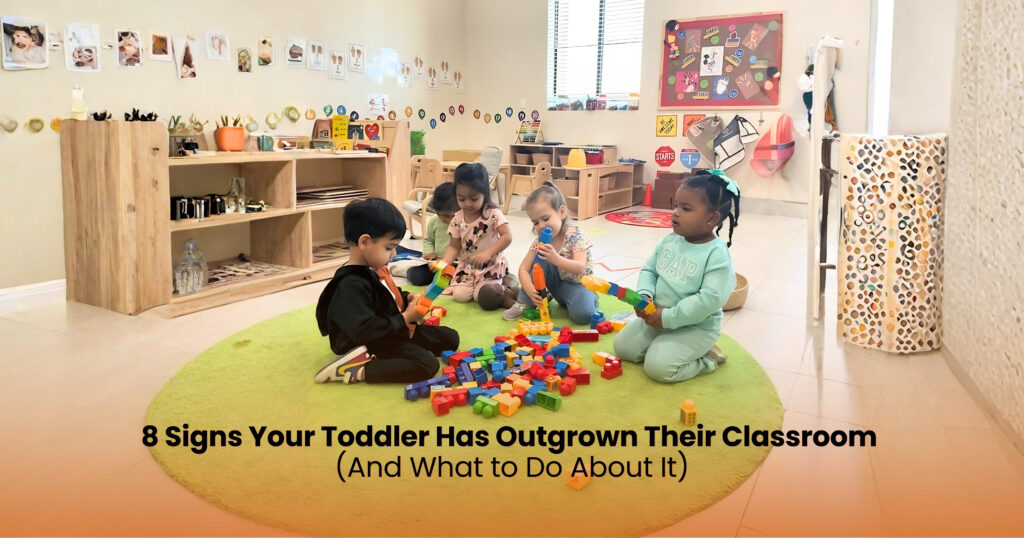
Toddlers are natural builders. They stack blocks as high as they can, then delight in the crash. Teachers offer simple language to describe what is happening. At this age, the process matters far more than the product.

Pre-Schoolers: Planning and Problem-Solving

This is where engineering becomes intentional. Children begin to build with a goal in mind. A house for the toy animals, a bridge for the cars. Children learn that problems are invitations to think, not reasons to give up.

Early Pre-K: Testing and Improving

Children now engage in the full design process: plan, build, test, improve. They might sketch their idea before building, then compare the result to their plan. Children learn to evaluate their own work and celebrate the process of improvement.

Pre-K (Kindergarten Readiness): Think Like an Engineer

Our oldest learners take on real engineering challenges. They work in pairs and small groups, learning to share ideas, listen to others, and solve problems together. These experiences build the foundation for the engineering practices they will encounter in kindergarten and beyond.

Our Teachers: Guides in the Building Process

Our educators are trained to recognize the engineering thinking hidden in children’s play. They don’t step in with answers; they ask the questions that move children forward: “What do you notice?” “What could you try next?” “How is this like something you built before?” 

Teachers observe closely, documenting children’s designs and problem-solving strategies. They introduce new materials at just the right moment to extend thinking. Most importantly, they create a classroom culture where trying, failing, and trying again are celebrated because that is exactly what real engineers do. 

Our Spaces: Built for Building

Every corner of our classroom invites engineering thinking. Blocks are stored at child height, organized by shape and size for easy access. Loose parts fill clear containers, inviting sorting, combining, and constructing. The building area is spacious enough for group projects, with a flat, sturdy surface for complex structures. Nearby, a small library of picture books about builders, architects, and inventors feeds imaginations. Every material has a place, and children learn to care for their tools and clean up after themselves. 

The Milestones Difference: Building Confidence Along With Structures

Every fallen tower teaches persistence. Every design that doesn’t work the first time teaches flexibility. Every successful structure, built with their own two hands, teaches confidence. Our approach weaves together Texas-aligned engineering practices, purposeful environments rich with real materials, and expert educators who know when to step in and when to step back. 

The result is a program where children learn to think like engineers: curious, persistent, creative, and ready to tackle any problem that comes their way. 

Ready to see young engineers at work?

Ready to see young engineers at work? 
Book your personal tour and meet our builders in action. 

Frequently Asked Questions

What does engineering look like for young children?

For young children, engineering is hands-on problem-solving. It might mean building a block tower that won’t fall, designing a ramp that makes cars go fast, or figuring out how to connect two pieces of cardboard. Every building project is a chance to think like an engineer. 

Yes. Engineering practices are explicitly part of the Texas kindergarten standards. Children are expected to identify problems, design solutions, create prototypes, and test their designs. Our Pre-K program builds the foundational skills for these expectations. 

Playing with blocks is a wonderful start. In our program, teachers extend that play by asking thoughtful questions, introducing new materials, and helping children work through problems. The block play is still there but with intentional guidance, it becomes rich with engineering thinking. 

Frustration is part of the engineering process. Our teachers are skilled at helping children work through it with gentle questions and encouragement. We celebrate trying again and learning from what didn’t work. Over time, children develop resilience and a “I can figure this out” mindset. 

Both. Children often begin building alone, then naturally draw others into their projects. Teachers also introduce partner and small-group challenges that build collaboration skills. Learning to share ideas and solve problems together is a key part of our program. 

We use a wide range of materials: unit blocks, magnetic tiles, interlocking bricks, cardboard, recycled items, natural materials, and simple tools like tape and child-safe screwdrivers. The variety ensures that children encounter new challenges and possibilities. 

Engineering connects naturally to math (measuring, counting, comparing), science (motion, gravity, materials), and literacy (documenting designs, telling stories about structures). Our integrated approach means engineering thinking supports learning across the curriculum.

Teachers observe and photograph children’s projects, noting their problem-solving strategies, collaboration, and persistence. These observations become part of your child’s portfolio, shared with you throughout the year. 

Our materials and challenges have no ceiling. A child who masters simple block towers can move on to complex structures with moving parts, multi-step designs, or projects that require collaborating with others. Teachers also introduce new materials and more open-ended challenges to extend thinking. 

Kindergarten science standards include engineering practices like asking questions, defining problems, designing solutions, and testing designs . Our program builds these skills through hands-on play, ensuring your child enters kindergarten with confidence and a strong foundation in engineering thinking. 

See Why Parents Trust Milestones Academy

See Why Parents Trust Milestones Academy
The Importance of STEM Learning in Early Childhood Education

The Importance of STEM Learning in Early Childhood Education

Walk into any preschool classroom and you will see something that looks like pure, unstructured play. Children are stacking blocks, splashing at water tables, counting colorful beads and sorting buttons into little piles. It is some of the most important learning happening anywhere in the world.  What looks like play is actually science in action.…