
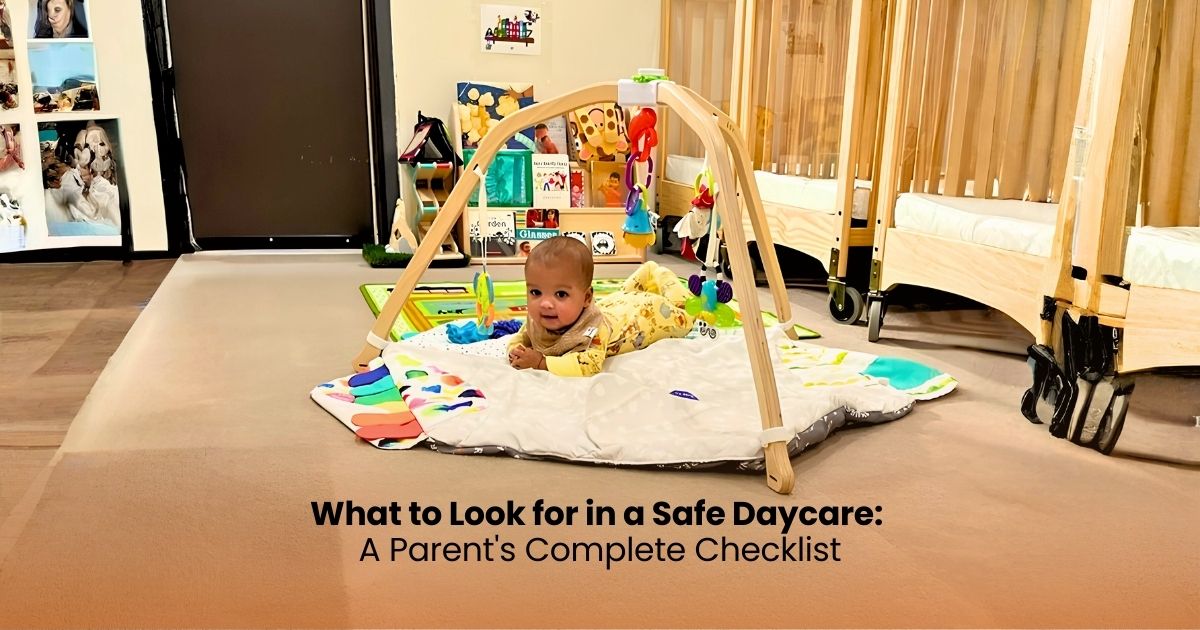
What to Look for in a Safe Daycare: A Parent's Complete Checklist
Every parent has stood in a daycare parking lot, five minutes before a tour, realizing they have no idea what to ask.
You walk in, someone smiles at you, the rooms look clean enough, and you nod your way through forty-five minutes. Then you go home and wonder if you actually learned anything useful.
Most parents don’t have a safe daycare checklist in their hands when they tour. Daycares know that. This guide is for the parents who want one.
We’ll go through every area that matters: security, staff ratios, cleanliness, food, and communication, so you can walk into any tour with real questions and leave with real answers. We’ll also cover the red flags worth walking away from, and include a printable checklist at the end you can use on every visit.
Physical Security: Who Can Walk In?
The moment you pull up, pay attention. Did you walk straight through the front door? Or did someone stop you, buzz you in, or ask who you were? Those first thirty seconds tell you a lot about how seriously a center takes access control.
What to look for:
-
Front entry requires a buzzer, keypad, or staff to physically let you in
-
Outdoor play areas have a separate gate code or fob
-
Staff ask for ID on pickup. Every time, even for familiar faces
-
There’s a written policy for what happens if someone unauthorized shows up
-
Security cameras cover entry points and the playground
A Milestones Academy parent mentioned that a teacher once asked him for ID even though she’d seen him before. He was a bit surprised, then grateful. That’s the standard you want protecting your child.
Licensing and Staff Credentials
Texas requires every childcare center to hold a license from the Texas Health and Human Services Commission (HHSC). That license is the minimum bar, not the finish line.
Before your tour, look up the center on the HHSC childcare licensing portal. You can read their full inspection history, including any violations and whether they were corrected. Do this before you visit, not after.
Things to check in person:
-
License is posted somewhere visible, not tucked away
-
Staff hold Child Development Associate (CDA) credentials or early childhood education degrees
-
Everyone on staff, including part-time workers and substitutes, has passed a background check
-
CPR and first aid certification applies to all staff, not just one person per building
-
The director or owner has a formal background in early childhood education
At Milestones Academy, owner Fazilat holds a professional background in Education. This means the person making decisions about curriculum and classroom practices actually understands child development.
Teacher-to-Child Ratios: The Number That Actually Matters
Research from the National Institute for Early Education Research (NIEER) consistently shows that lower teacher-to-child ratios are directly tied to better language development and school readiness outcomes.
Texas minimums:
-
Infants (0–18 months): 1 caregiver per 4 children
-
Toddlers (18 months–3 years): 1 caregiver per 9 children
-
Pre-K (3–5 years): 1 caregiver per 15 children
Lower ratios mean more eyes on each child. Ask whether the center consistently stays below the maximum, or whether they run at the limit every day.
The question most parents skip: “What happens to ratios when a teacher calls in sick or takes a break? Do classrooms get combined?”
That’s the moment standards slip. A good center has a real backup plan. Ask for it.
Cleanliness and Health Policies
Young children spend a lot of time on the floor. They touch everything and put things in their mouths. Their immune systems are still developing. A center that treats cleanliness casually will show you that during the tour, you just have to look.
What to observe:
-
Floors, toys, and surfaces look genuinely clean and not just organized
-
Diaper-changing areas have disposable liners and get wiped down between each use
-
Teachers wash their hands before meals and after diaper changes
-
The center has a written sick-child policy and actually enforces it
-
Food comes from a licensed kitchen, with clear allergy protocols
Pay attention to bathrooms in particular. They’re harder to keep up during a busy day, so the state of the bathroom often reflects the daily standard better than any room that was prepped for your visit.
Emergency Procedures
Every decent daycare has an emergency plan written down somewhere. The question is whether the staff actually know it or whether the binder just sits in a drawer.
Ask these directly:
-
“Where do children go during a fire drill or evacuation?”
-
“How often do you run drills?”
-
“Who contacts parents in an emergency and what happens if you can’t reach us?”
-
“What do you do if a child has a severe allergic reaction?”
-
“Do you document minor injuries and tell parents the same day?”
If a director gets flustered by these questions, take note. A well-run center answers them without hesitation because they’ve thought through every scenario before it happens.
Food: What Is Your Child Actually Eating?
Many daycares bring in food from outside vendors or rely on parents to pack lunches. That’s not necessarily a problem, but it puts the responsibility on you to track what your child is getting each day.
Centers that prepare meals in-house tend to have more control over quality, portion sizes, and dietary accommodations. Ask to see the weekly menu. Ask what they do when a child has a food allergy.
Basics to confirm:
-
Meals are made in a licensed, inspected kitchen
-
The weekly menu is posted or available on request
-
The center can accommodate food allergies
-
Staff are trained on allergy responses, not just aware of them
At Milestones, meals are prepared fresh in-house every day by our kitchen team. Parents bring it up in reviews regularly and it shows up in how the kids feel and focus in the afternoon.
Staff Stability: Are Teachers Actually Staying?
High staff turnover is one of the most reliable warning signs in early childhood care. Kids form attachments quickly. When teachers leave constantly, it disrupts routines, reduces trust, and usually signals something’s wrong behind the scenes.
Watch for:
-
Teachers greet kids by name as they come in and kids respond warmly
-
The classroom feels settled, not chaotic
-
Staff talk positively about the center without being asked
-
The director or owner is present on the floor, not just in an office
At Milestones, teachers like Ms. Jenn, Ms. Zevar, and Ms. Andrea have been with us long enough that families know them by name before the first day. That continuity matters to kids far more than most parents expect.
Parent Communication
Dropping your child off and hearing nothing until pickup is not acceptable and good daycares know that.
What strong communication looks like:
-
Daily updates with photos or short notes not just a pickup summary
-
Same-day notification for any fall, bump, or unusual behavior
-
Teachers who give specific answers, not “they had a great day”
-
An open-door policy. You can stop by without a formal appointment
A 2022 study published in Early Childhood Education Journal found that consistent, specific communication from caregivers to parents was one of the strongest predictors of parental confidence and children’s emotional adjustment in childcare settings.
Red Flags That Should Make You Think Twice
Sometimes you don’t need a full evaluation. Some things are simply a sign to keep looking.
-
Staff seem irritated by your questions or dodge them with vague answers
-
The licensing paperwork isn’t posted, or the director hesitates to produce it
-
Multiple classrooms have had “recent changes” to teaching staff
-
Children look disengaged or upset throughout your visit
-
Ratios are described as “flexible” depending on the day
You’re not being difficult by asking hard questions. You’re being a parent.
Bring This on Every Tour — Safe Daycare Checklist
Print this or pull it up on your phone. Go through every item before you leave.
| What to check | Yes | No |
|---|---|---|
| Front entry requires buzzer, keypad, or staff to let you in | ☐ | ☐ |
| Outdoor play areas have a separate code or gate lock | ☐ | ☐ |
| Staff verify ID on every pickup, including familiar faces | ☐ | ☐ |
| Security cameras cover entry points and the playground | ☐ | ☐ |
| Current Texas childcare license is posted visibly | ☐ | ☐ |
| Inspection history is clean (verify on the HHSC portal before visiting) | ☐ | ☐ |
| All staff have passed background checks, including substitutes | ☐ | ☐ |
| CPR and first aid certification applies to every staff member | ☐ | ☐ |
| Teacher-to-child ratios stay below Texas maximums | ☐ | ☐ |
| Ratios hold when a teacher is absent or on break | ☐ | ☐ |
| Classrooms and bathrooms look clean during an unplanned walkthrough | ☐ | ☐ |
| Sick-child policy is clear and actually enforced | ☐ | ☐ |
| Diaper areas are sanitized between each use | ☐ | ☐ |
| Meals come from a licensed kitchen with a posted weekly menu | ☐ | ☐ |
| Allergy accommodations are documented and staff are trained on them | ☐ | ☐ |
| Emergency and evacuation procedures are written and practiced regularly | ☐ | ☐ |
| First aid kits are in every classroom | ☐ | ☐ |
| Parents are notified the same day for any injury or incident | ☐ | ☐ |
| Daily updates include specific notes or photos — not just a pickup summary | ☐ | ☐ |
| Parents can visit without a scheduled appointment | ☐ | ☐ |
| Most teaching staff have been at the center for more than one year | ☐ | ☐ |
| Teachers greet kids by name and kids respond warmly | ☐ | ☐ |
| Director or owner is present on-site most days | ☐ | ☐ |
Now, Come See It for Yourself
Everything on this safe daycare checklist is something we do every day at Milestones Academy of Texas in Lewisville.
Our front entry is secured. Staff check ID, every time. Ms. Zoraima prepares fresh meals in-house daily. Teachers have been here long enough that kids run to them at drop-off. And our owners, Fazilat and Malik, are here on-site, not just names on a website.
We serve families in Lewisville, Carrollton, and The Colony, with programs for children from 6 weeks through Pre-K.
Bring the checklist. Ask us everything. We’ll have answers.
See Milestones Academy in Person
Visit our Lewisville campus, meet the educators, and ask the questions that matter to your family.
Ten questions to ask on a Texas daycare tour
- What is the operation name listed in the Texas Child Care Search?
- How are classroom ratios checked during arrivals, departures and transitions?
- How are visitors and pickup adults verified?
- How will the school contact me after an injury, illness or safety concern?
- What training and background checks are required for staff?
- How are infant sleep, feeding and bottle labels handled?
- How are allergies and medication plans documented?
- What is the emergency and severe-weather procedure?
- How does the school explain and correct a licensing deficiency?
- What should I expect after I submit an enrollment or tour request?
Verify the operation through the official Texas Child Care Search. Then review our School Safety approach and compare the public record with what you observe during a tour.