

The Conversation Most Parents Get Wrong Before the First Day of Preschool
You’ve bought the backpack. You’ve done the school visit. There’s still one thing that can unravel all that prep in thirty seconds, and most parents don’t realize they’re doing it.
It’s the week before preschool starts. You’ve ticked every box on every checklist you could find. The lunchbox is labelled. The goodbye ritual is practiced. You’ve read Llama Llama Misses Mama so many times you can recite it in your sleep.
And then, on the morning of Day One, you kneel down, look your little one in the eye, and say: “Oh sweetheart, I’m going to miss you SO much today.”
Without meaning to, you’ve just told your child there is something to miss. Something to mourn. Something worth being anxious about.
This is the conversation most parents get wrong, and it’s rarely about a lack of love or effort. When it comes to talking to your toddler about new school, what you say to yourself beforehand shapes the words that actually come out.
Your child is reading you, not the room
Preschool teachers will tell you they see the same thing every September. A child walks in completely settled, right up until they catch their parent’s expression. Then the wobble starts.
Young children are wired to use their parent’s emotional state as a safety signal. This is developmentally normal and actually very useful in most situations. The challenge is that it works against you on the first day of preschool: if you look unsettled, your child’s brain registers that there is something to be unsettled about.
Research from Zero to Three, one of the leading early childhood development organizations in the US, confirms that children as young as two actively monitor their caregiver’s expressions and body language when entering unfamiliar settings. A calm, matter-of-fact parent at drop-off makes an enormous difference.
What not to say, and what to say instead
Most advice about talking to your toddler about new school covers the logistics: routines, comfort objects, the right books to read. What gets skipped is the actual language. Certain phrases, all said with the best intentions, can quietly prime a child for anxiety before they’ve taken a single step through the door.
Instead of: “I’ll miss you SO much today.”
Why it backfires: Signals loss and separation, even when said warmly.
Try this: “I’ll be thinking about all the fun things you’re doing. See you after [anchor activity]!”
Instead of: “Don’t worry, it’ll be fine!”
Why it backfires: The word ‘worry’ puts the idea in their head. If there was nothing to worry about, it wouldn’t need a mention.
Try this: “You know what’s there? The big sandpit. And Miss [name]. She’s going to love meeting you.”
Instead of: “Isn’t this SO exciting?!”
Why it backfires: Over-hyping tells your child this is a Very Big Deal, which can increase anxiety rather than ease it.
Try this: Keep it ordinary. “Today’s a school day. After, we’ll come home and have [favourite snack].”
Instead of: “Be brave!”
Why it backfires: Implies there’s something to be brave about.
Try this: “You’re going to have a great time. And I’ll be right here at pick-up.”
Instead of: “If you don’t like it, tell me.”
Why it backfires: Opens the door to not liking it before they’ve even arrived.
Try this: “Tell me what you built today when I pick you up!”
Age matters when you’re having this conversation
A 2-year-old and a 4-year-old need very different versions of the preschool transition conversation. Adjusting your approach to where your child actually is developmentally will save you a lot of frustration on both sides.
For a 2-3 year old: Long explanations don’t land at this age. What works is repetition and physical familiarity. Walk past the school on the weekend. Point to the door. Say “Your school!” in the same cheerful tone you’d use for “The park!” That is genuinely enough at this stage.
For a 4-5 year old: They can hold a simple, calm preview of the day. “First you’ll hang up your bag. Then Miss [name] will do circle time. Then snack. Then I’ll come get you.” Give them the sequence in order, without drama, and let it sit.
If your child seems to go ‘backwards’, that’s normal
Some children start having toilet accidents the week before preschool begins. Others suddenly want to be fed, dressed, or carried again, even though they’ve been managing these things independently for months.
This is called regression, and it is your child’s nervous system drawing on comfort and familiarity when something unfamiliar is coming. It is not a warning sign. Being patient with them during this phase tends to resolve it much faster than pushing back against it.
Starting preschool anxiety in children is also extremely common. The National Association for the Education of Young Children (NAEYC) is clear that separation is a process, for children and parents alike, and that giving children time and space to adjust consistently outperforms forcing the transition.
The night-before conversation that actually helps
Pack the bag, yes. Choose the outfit, sure. But the single most useful thing you can do the evening before the first day is a quick, low-key chat about what tomorrow morning will look like.
Something like: “Tomorrow’s a school day. We’ll drive to Milestones, you’ll say hi to Miss [name], and I’ll pick you up after outdoor play. Then we’ll have [favorite snack] at home.”
No big build-up. No extra reassurance. The goal is to deliver this in a tone that says: this is a completely ordinary Tuesday. Because that’s what it should feel like to them.
The pick-up anchor matters more than parents realize. Young children don’t have a concept of “3pm”. Tying your return to a specific event in their school day, like outdoor play or snack time, gives separation a concrete end point they can actually picture.
Starting preschool anxiety is normal for parents, too
Something the parent-prep articles tend to skip: you might be the one who cries at drop-off. And that is completely fine. What matters is that your child doesn’t see it at the door, because they will take their cue from your face in that moment.
Starting preschool anxiety in parents often comes out in the conversations leading up to the first day: over-explaining, over-reassuring, or checking in repeatedly with “Are you sure you’re okay with this?” Each well-meaning question introduces a doubt the child hadn’t had.
The practical fix is to process your own feelings before you get to the school gate. Talk to your partner, a friend, or another parent going through the same thing. Just not your two-year-old.
A quick recap: preschool transition tips that actually matter
- Check your own emotions at the door. Your calm is the most useful thing you can bring.
- Use matter-of-fact language, not big feelings language. Ordinary tone, ordinary morning.
- Adjust the conversation to your child’s age: repetition for toddlers, a clear sequence for pre-K.
- Skip the over-explaining, over-reassuring, and over-hyping.
- Know what your child’s day looks like, so you can describe it accurately and calmly.
- Expect regression. It passes faster when you don’t fight it.
- Keep the goodbye brief, warm, and the same every single day.
Come and see what your child’s day actually looks like
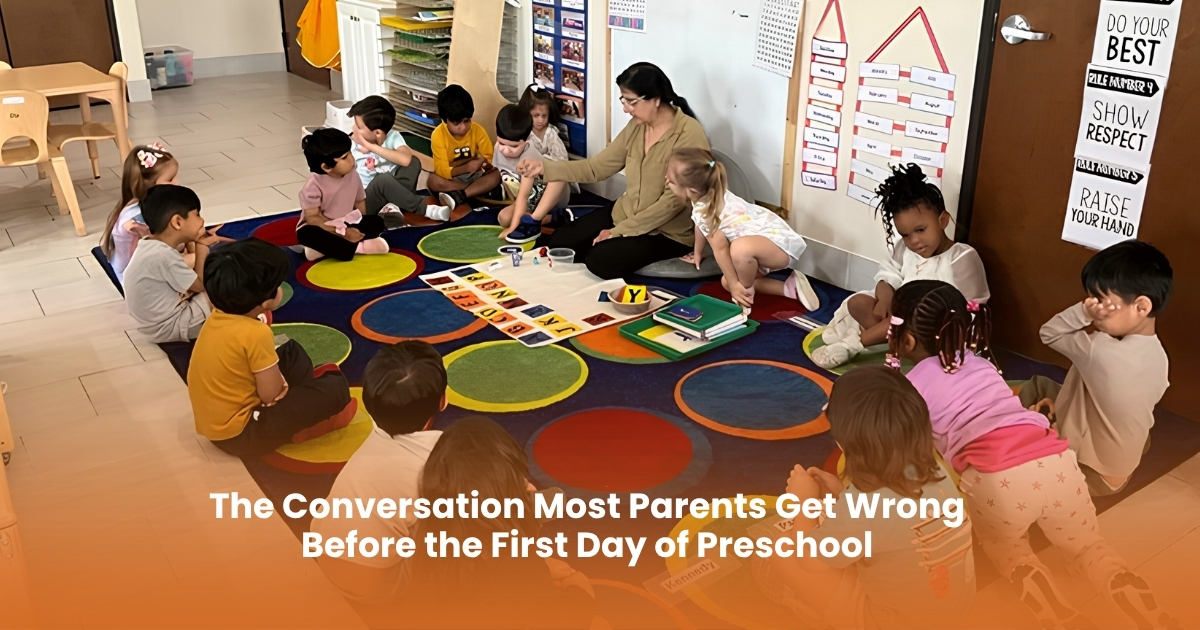
The most effective way to get talking to your toddler about new school right is to actually know what their day looks like. The specific sequence. The hook where the bag goes. The teacher’s name. The snack time. The outdoor play.
Parents who have visited the school before the first day can describe the morning in concrete detail. Their children arrive with a mental picture of what’s coming, rather than walking into an unknown. That difference shows up immediately at drop-off.
A tour of Milestones Academy gives you exactly that. Come and meet the teachers. See where the bags go. Walk through a typical morning. You will leave knowing enough to have a calm, specific first-day conversation with your child, and that calm will carry both of you through the door.
Book a Tour at Milestones Academy
Meet the teachers, see the classrooms, and walk through a typical morning. Leave with everything you need for a confident first-day conversation with your child.
Serving families in Lewisville, The Colony, and Carrollton.
See Milestones Academy in Person
Visit our Lewisville campus, meet the educators, and ask the questions that matter to your family.