
Bilingual Preschool in Texas: What Language Exposure Before Age 5 Can Look Like
If you have spent any time in a parenting group, you have probably heard some version of this warning: your child’s window for learning a second language closes at age five, and after that, the door is basically shut. It is a scary thing to hear when your kindergartner is still working on English. It is also not quite right.
The real story is more interesting, and more useful for families comparing bilingual preschool Texas options for a toddler. There is a window that closes early, but it is not the one most parents worry about. There is another window that stays open far longer than anyone tells you. And there is a third reason preschool age still matters, one that has nothing to do with windows closing at all.
The Myth Everyone Gets Half Right
The “critical period” idea comes from real linguistics research, so the instinct to take it seriously is a good one. Where things get muddled is the specific age attached to it.
A 2018 study out of MIT, Boston College, and Harvard analyzed a grammar quiz taken by roughly 669,000 people and found that the ability to learn a language’s grammar to a native-like level stays strong until around age 17.4, a decade later than the commonly cited cutoff. Learners who start a new language between 10 and 18 still pick up grammar quickly. They simply have a shorter runway before that ability begins to taper off, which is why they typically land just short of native-level fluency rather than missing the target completely.
So if your child is four, five, or six and hasn’t been exposed to Spanish yet, the grammar door has not slammed shut. That part of the story is genuinely reassuring.
What Actually Closes Early: The Sound Window
Preschool timing does matter for one piece of this puzzle, and it starts well before preschool even begins. Long before children ever produce a sentence, their brains are busy sorting out which sounds belong to their native language and which do not.
Researchers Janet Werker and Richard Tees documented this in a now-classic set of studies: babies are born able to distinguish between speech sounds used across virtually every language on earth. Between roughly six and twelve months, that ability narrows. Infants get sharper at hearing the sound contrasts of the language(s) around them and lose some sensitivity to contrasts that do not appear in their environment.
This is the window that actually closes early, and it is about sound perception, not grammar or vocabulary. A child who hears Spanish regularly during infancy and toddlerhood has an easier time later producing Spanish sounds without the flattening that comes from learning a language purely through a classroom, years after this perceptual tuning has already settled.
None of this means a five-year-old cannot develop excellent Spanish pronunciation. It means the earliest years offer a genuine head start on the accent piece specifically, which is one small but real reason “the earlier, the better” isn’t just a marketing line.
So Why Does Preschool Age Still Matter?
If grammar stays learnable into the teenage years and the sound window is really about infancy, you might wonder why preschool gets so much attention in bilingual education conversations. The answer has less to do with a closing door and more to do with what preschool-age brains are already good at.
Research on bilingual toddlers and preschoolers has repeatedly found measurable differences in executive function, the mental skills involved in switching attention, ignoring distractions, and holding information in mind. Studies of 3- to 4-year-olds have detected a bilingualism effect on selective attention and cognitive switching, and even 7-month-old infants raised in bilingual homes have shown differences in cognitive control tasks compared with monolingual peers.
A few other practical reasons preschool is a genuinely good window, separate from any critical period argument:
- Young children absorb new sounds and vocabulary through play, songs, and repetition rather than deliberate study, so a second language enters through the same channels as their first one.
- Preschoolers are not yet self-conscious about “getting it wrong,” which makes them far more willing to attempt new words out loud than an older child or adult.
- Daily immersion in songs, routines, and stories, the kind built into a bilingual preschool day, gives children the repeated, low-stakes exposure that vocabulary acquisition depends on.
Taken together, preschool works less like a last chance and more like a convenient one, with cognitive perks that show up whether or not a child grows up fully bilingual.
Why This Conversation Looks Different in Texas
For families elsewhere, bilingual education can feel like an enrichment extra. In Texas, it is closer to a practical skill for daily life. Recent Census Bureau estimates show that roughly 28 percent of Texas households speak Spanish at home, and about 35 percent speak a language other than English as their shared household language.
That means a huge share of the kids your child will sit next to in elementary school, and later work alongside as adults, are growing up bilingual or come from Spanish-speaking households. A child who has some comfort with Spanish sounds and vocabulary before kindergarten is stepping into a classroom and a community where that skill is genuinely in use, not just a line on a college application years down the road.
The Texas Education Agency has also built specific guidance for supporting emergent bilingual children in early childhood classrooms, reflecting how central this is to early education policy across the state. Bilingual readiness in Texas is not a niche interest. It is closely tied to how the state’s schools and communities actually function, and it is a big part of why bilingual preschool Texas programs have become a mainstream request rather than a specialty one.
What This Looks Like in an Actual Classroom
Theory is one thing. What matters for a parent comparing preschools is what a bilingual program actually does with a three-year-old’s day.
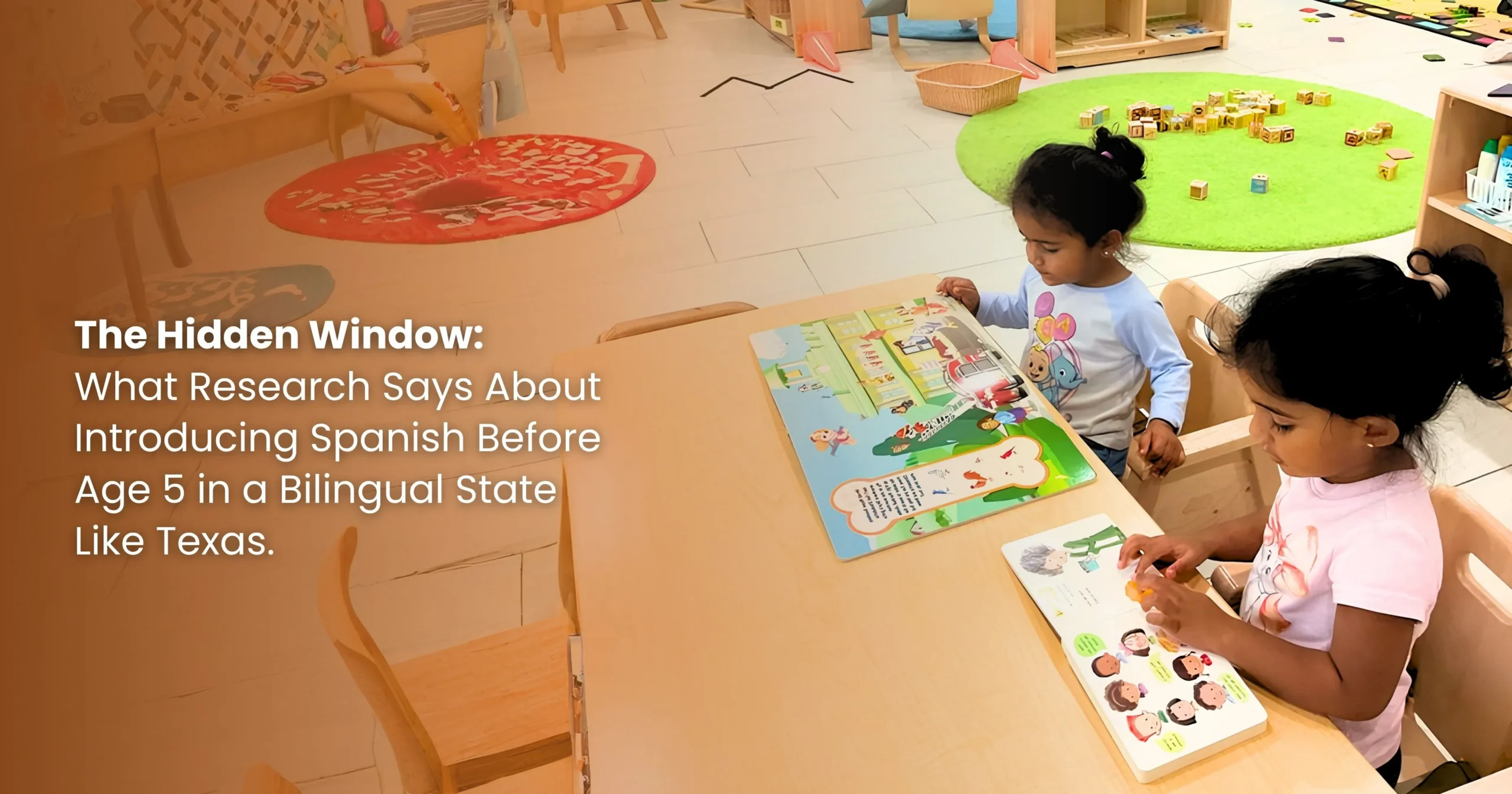
At Milestones Academy, Spanish and Chinese are introduced starting in infancy through our Languages program, built around songs, rhymes, storytelling, and daily routines rather than seated lessons. Toddlers pick up words like “agua” at the water table and “ni hao” during morning greeting, right alongside their growing English vocabulary. By early Pre-K, children are holding short conversations and comparing how different cultures celebrate holidays, all before they ever sit down for a formal grammar lesson.
Mixing languages along the way is completely normal. It is not a sign of confusion. It is what a developing bilingual brain does while it sorts two vocabularies into place, and it tends to resolve on its own with continued exposure.
This kind of immersion works because it fits inside a broader teaching philosophy built around structured routines, purposeful play, and individualized attention, the same foundation that supports early literacy, math, and social-emotional growth. Language is not bolted onto the day. It runs through it.
“But We Don’t Speak Spanish at Home”
This is one of the most common questions from parents looking into a bilingual preschool in Lewisville, and the answer is straightforward: it does not matter. Early language learning in a classroom setting does not require any Spanish at home. Teachers who are native or heritage speakers carry the language load during the day, and children pick up songs, greetings, and vocabulary the same way they pick up anything else in a preschool routine, through repetition and relationships, not homework.
Families choose Spanish-inclusive programs specifically because they want to hand their child an opportunity they did not have themselves. That is a completely reasonable starting point, and it works. A three-year-old does not need a bilingual household to benefit from daily exposure to a second language. They need consistent, playful exposure, which is exactly what a well-run classroom is built to provide.
A Few Ways to Support It at Home
Even without fluency yourself, there are small things that reinforce what a bilingual classroom is already doing:
- Ask your child to teach you the words or songs they learned that day. Being the “expert” is motivating for a preschooler.
- Look for Spanish-language picture books or bilingual storytime at your local library.
- Use children’s shows or music in Spanish occasionally, not as a replacement for classroom learning, but as extra exposure to the same sounds.
- Resist correcting mixed-language sentences too quickly. Early code-switching is a normal part of building two vocabularies, not a mistake to fix.
None of these require you to be bilingual. They just extend the same low-pressure exposure that makes preschool such a workable window for Spanish for toddlers in the first place.
Deciding What’s Right for Your Family
A child who starts Spanish at age six isn’t behind for life, and skipping bilingual exposure in the early years isn’t a mistake you can’t undo either. What the research actually supports is narrower and more useful than either extreme: the earliest years offer a real advantage for sound and pronunciation, the grammar window stays open much longer than commonly believed, and the preschool years are simply a comfortable, low-pressure time to begin, with cognitive benefits that show up regardless of eventual fluency.
For families in Lewisville, Carrollton, and The Colony researching bilingual preschool Texas programs, that combination is worth taking seriously, not because of a myth about a door slamming shut, but because early language exposure genuinely supports how children think, listen, and connect with the community around them.
If you are exploring preschool options in Lewisville, TX and want to see what daily bilingual learning actually looks like for toddlers and preschoolers, we would love to show you around.
Tour our Spanish-inclusive program at Milestones Academy of Texas. Book a visit or call (469) 962-6886 to see a real classroom in action.