

Montessori vs. Play-Based Preschool in Lewisville: A Fair Comparison
Compare Montessori and play-based preschool in Lewisville by classroom setup, teacher role, materials, routines, and tour questions for parents.
That moment when a toddler hands you “one more” cracker? That’s early number sense. When a preschooler lines up all the red blocks in a row? That’s classification and pattern recognition taking shape. Our program transforms everyday moments into rich mathematical explorations. Through hands-on materials, purposeful play, and intentional guidance aligned with Texas Prekindergarten Guidelines, we help children build the foundational numeracy skills they need for kindergarten and beyond.
At Milestones Academy, numbers come alive through touch, movement, and play. Children understand mathematical concepts best when they can see them, touch them, and live them. We move beyond worksheets and rote memorization to provide authentic, hands-on experiences where mathematical thinking is woven into everything we do. Through an intentional, inquiry-based approach aligned with Texas guidelines, we cultivate confident problem-solvers who approach numbers with curiosity and joy.
Shapes come alive through construction and creative play:
Wooden shape puzzles, geoboards, pattern blocks, and magnetic shapes.
Spheres, cubes, cones, and cylinders in various sizes for exploring solid shapes.
Play dough and shape stamps, stick-and-stone shape building outdoors.
We believe children deserve authentic, beautiful materials that invite mathematical thinking:
Wooden counters, linking cubes, ten-frames, number cards, and counting trays.
Beads, buttons, sorting trays, colored tiles, and natural loose parts.
Play cash registers, clocks, calendars, and classroom graphs.
Mathematical thinking develops gradually, building from simple sensory experiences to complex problem-solving. Our curriculum follows the developmental pathways outlined in the Texas Prekindergarten Guidelines, ensuring each child builds a strong foundation at their own pace.
Sensory Exploration of Quantity & Space Experiencing number and space through the senses.
Beginning Number & Spatial Concepts Exploring quantities, filling and dumping, and using simple position words.
Number Sense, Shapes & Early Patterns Counting, recognizing shapes, and beginning to identify patterns.
Deeper Number Sense, Operations & Measurement Counting to higher numbers, beginning addition/subtraction, and measuring.
Composing Numbers, Data & Complex Patterns Understanding number composition, collecting data, and creating patterns.
Our mathematics curriculum grows alongside your child. Each stage builds on the last, ensuring concepts are introduced when children are developmentally ready to understand them.
Long before infants can count, they absorb the building blocks of mathematical thinking. They grasp one rattle, then another. They notice when a toy is taken away. They explore the space inside a bucket and the feeling of objects moving from hand to hand.
Toddlers are natural mathematicians. They want more crackers. They notice when their cup is empty. They dump out a basket of blocks and marvel at the pile. Teachers honor this curiosity by providing rich opportunities for mathematical exploration. At the water table, children fill and empty containers of different sizes. During snack, they count out crackers together.
At this age, counting becomes intentional. Children count the children at morning meeting, the crackers on their plate, and the steps to the playground. Teachers introduce counting with one-to-one correspondence, helping children understand that each object gets one number. Shape hunts reveal circles in clock faces and squares in windows. Simple patterns emerge in songs and movement games.
This is where mathematical thinking deepens. They begin to understand that the last number they say tells "how many" (cardinality). They explore what happens when you add one more or take one away. They measure their constructions with unit blocks and their own hands. Teachers intentionally introduce mathematical vocabulary, always in the context of real experiences.
Our oldest learners engage with mathematics as a tool for understanding their world. They collect data about classroom preferences and represent it in simple picture graphs. They use mathematical language to compare, describe, and explain. These experiences build the foundation for the mathematical thinking they will encounter in kindergarten and beyond.
Our educators are trained to recognize the mathematical thinking hidden in children’s everyday play. They carefully select materials that invite mathematical exploration. They document children’s mathematical thinking through photos and observations, sharing these discoveries with families. Most importantly, our teachers model a positive relationship with mathematics. They approach numbers with curiosity and joy, showing children that math is not something to fear, but something to explore.
In our classrooms, mathematics is woven into every part of the day. The block center invites counting, measuring, and spatial reasoning. The art area overflows with shapes, patterns, and symmetry. The snack table offers natural opportunities for counting, dividing, and comparing. The outdoor playground is rich with mathematical possibilities: counting steps, comparing heights and exploring patterns in nature. The result is an environment where mathematical thinking is not a subject to be studied, but a natural part of everyday.
Every time a child figures out how many cups are needed for snack, they build problem-solving skills. Every time they notice a pattern in the world around them, they build observation and reasoning. Every time they explain their mathematical thinking, they build communication and confidence. Our approach weaves together Texas-aligned mathematics guidelines, purposeful environments rich with real materials, and expert educators who know when to step in and when to let children discover for themselves. The result is a program where children learn to approach numbers with curiosity, confidence, and joy.
From child-sized safety goggles to securely anchored structures in our nature garden, we create thoughtful boundaries that allow for boundless learning. Our teachers are vigilant co-explorers, fostering resilience and innovation within a nurturing and protected space.
Ready to see young mathematicians at work?
Book your personal tour and meet our learners in action.
Math is taught through hands-on, playful experiences, not worksheets. Children count objects during daily routines, explore shapes with pattern blocks, compare quantities at the water table, and create patterns with beads and natural materials. Every activity is designed to make mathematical thinking concrete and meaningful.
Yes. Our mathematics curriculum follows the Texas Prekindergarten Guidelines, which outline developmental expectations in five domains: Number Sense, Joining and Separating, Geometry and Spatial Sense, Measurement, and Classification and Patterns.
By kindergarten, children benefit from being able to count to 30, recognize numerals 0-10, count up to 10 objects with one-to-one correspondence, name common shapes, use comparative language (more/less, bigger/smaller), and recognize simple patterns. Our program builds these skills gradually through developmentally appropriate activities.
Our materials and activities have no ceiling. A child who masters counting can explore number composition (how many ways to make 5), simple addition and subtraction, collecting and graphing data, and creating complex patterns. Teachers also introduce more open-ended challenges and new mathematical vocabulary to extend thinking.
Mathematics connects naturally to science (measuring, comparing data), engineering (building, spatial reasoning), art (shapes, patterns), and literacy (sequence, positional words). Our integrated approach means mathematical thinking supports learning across the curriculum.
Every child develops at their own pace. Our teachers observe carefully, noting each child’s understanding and providing additional support and practice through hands-on activities. We celebrate effort and progress, building confidence along with skills.
Teachers observe and photograph children’s mathematical explorations, noting their counting strategies, shape recognition, pattern creation, and problem-solving approaches. These observations become part of your child’s portfolio, shared with you throughout the year.
Technology plays a small role in our mathematics program. We occasionally use tablets to document data, create simple graphs, or explore math-focused apps, always briefly and with teacher guidance. The overwhelming focus is on hands-on, concrete materials.
Math is everywhere at home! Count steps as you walk, sort laundry by color, compare the sizes of fruit at the grocery store, notice patterns in books and on clothing, and use mathematical language in everyday conversation. Your teacher can share specific activities tied to what we are exploring in class.
The Texas Education Agency requires that school systems collect student progress data in mathematics for all eligible 4-year-old prekindergarten students, using an instrument from the Commissioner’s List of Approved Prekindergarten Progress Monitoring Instruments. Families are encouraged to receive updates on their child’s progress in mathematics at least 3 times a year.
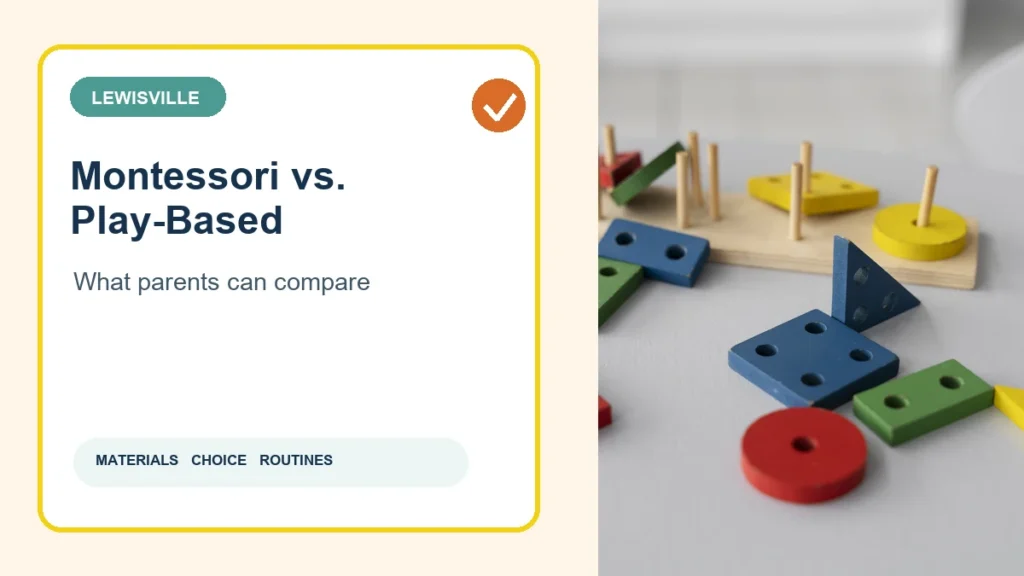
Compare Montessori and play-based preschool in Lewisville by classroom setup, teacher role, materials, routines, and tour questions for parents.