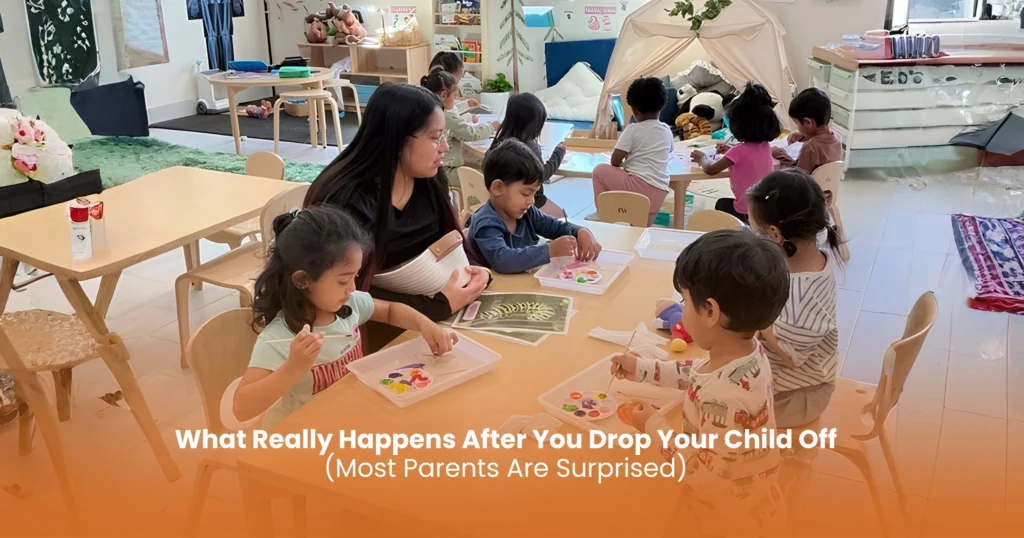

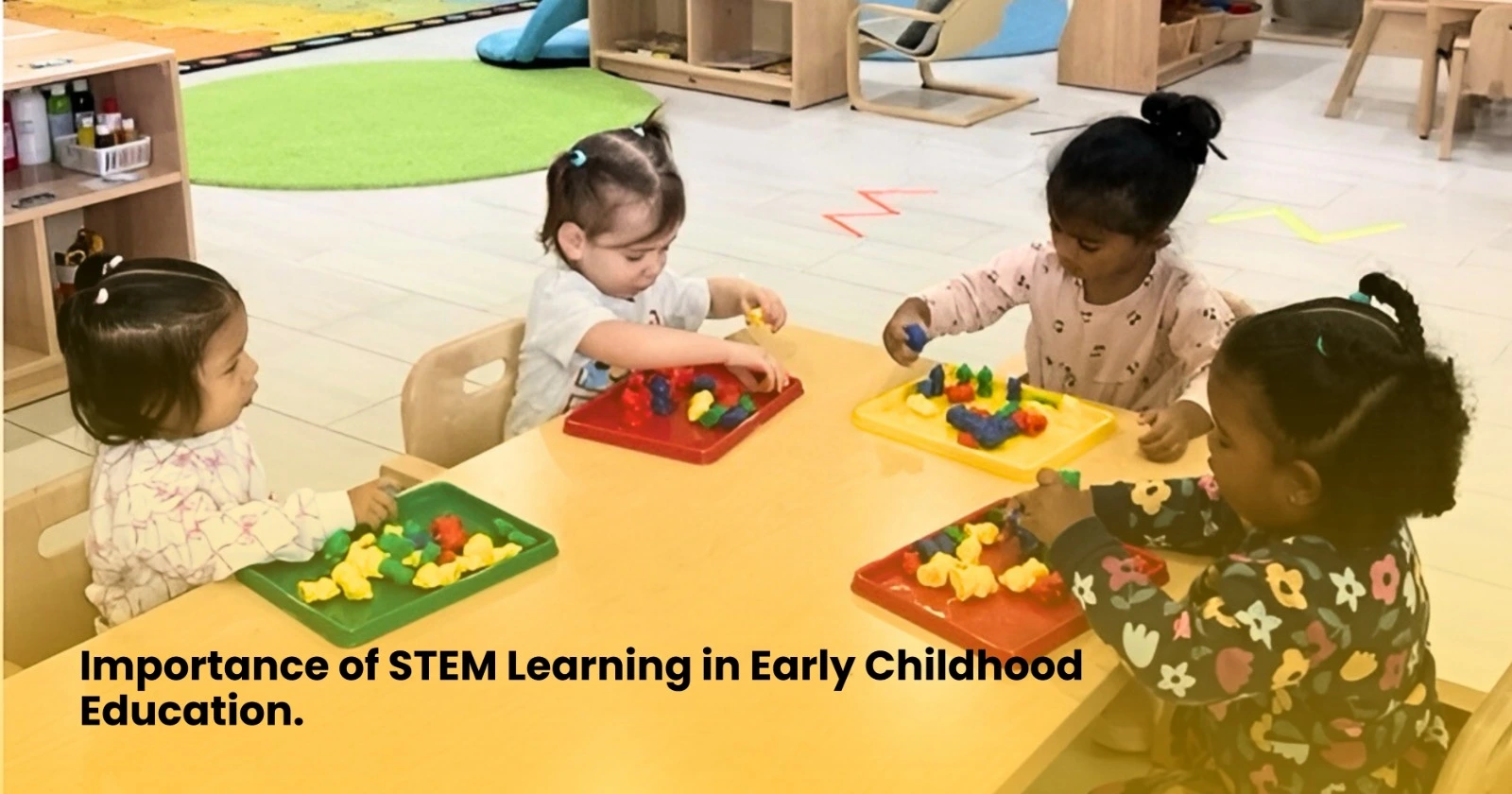
Walk into any preschool classroom and you will see something that looks like pure, unstructured play. Children are stacking blocks, splashing at water tables, counting colorful beads and sorting buttons into little piles. It is some of the most important learning happening anywhere in the world.
What looks like play is actually science in action. It is engineering, mathematics, and the very first seeds of thinking. These simple activities quietly shape the neural pathways that children will rely on for the rest of their academic lives. And the research is clear: the earlier children are introduced to STEM (Science, Technology, Engineering, and Mathematics), the stronger and more confident their foundations become.
Let’s explore how building this mindset helps young ones develop confidence and gives them the tools to enjoy learning for a lifetime.
Why STEM in Preschool Matters
The early childhood years, especially ages 2 to 6, represent an extraordinary window for brain development. A baby’s brain forms over one million new neural connections every second, and by age 5, the brain has already reached approximately 90% of its adult size.
Introducing STEM is not about getting a head start on homework. It is about building the mindset and the cognitive tools that make learning feel possible.
Starting Earlier Than You Think
There is a common assumption that STEM belongs in middle school labs and high school classrooms, not preschool sandboxes. But developmental science tells a very different story.
Research published by the National Association for the Education of Young Children (NAEYC) found that young children are fully capable of engaging in scientific practices and that among preschool-aged children, early math knowledge is actually a stronger predictor of academic achievement than early reading or attention skills.
Children are naturally wired to explore. They pick up rocks to examine them, they drop objects to watch them fall, they ask “why” approximately one hundred times a day. That instinct is not accidental. It is the biological engine of STEM thinking, and early education programs that channel it intentionally give children an enormous advantage.
Building Problem-Solvers from Day One
One of the most valuable outcomes of early STEM education is the development of genuine confidence in problem-solving. When a three-year-old tries to stack blocks into a tower and it collapses, something remarkable happens. Most children do not give up. They study the rubble, adjust their approach, and try again. That is the scientific method in its purest form, and it is happening at snack-table height.
They learn that problems are solvable, that failure is informative rather than final, and that persistence pays off. These lessons, absorbed through play in the preschool years, become the bedrock of academic resilience throughout a child’s education.
Feeding Curiosity Instead of Suppressing It
Young children are curious, and one of the most powerful things early STEM learning does is validate and direct that curiosity instead of reigning it in. STEM-rich classrooms teach children that questions are good, that exploration has value and that not knowing the answer is the perfect starting point for discovery.
This mindset, the willingness to wonder openly and investigate patiently, is exactly the disposition that scientists, engineers, and innovators carry throughout their careers.
Connecting Math, Literacy, and Critical Thinking
STEM education in the early years also builds critical thinking skills that go beyond math and science. Children who observe, compare, sort and measure are developing analytical muscles they will use when reading a complex text, evaluating an argument or navigating a social conflict.
Counting games and measurement activities forge early and powerful connections between numerical thinking and language, helping children understand that numbers, like words, are tools for making sense of the world.
What STEM Looks Like in a Preschool Classroom
Step inside our STEM-rich preschool and you won’t find rows of desks or lessons copied from a board. What you’ll find instead is a room full of young scientists, engineers, and mathematicians doing what they do best: getting their hands dirty and figuring the world out.
Here’s how we do that:
Forget the Textbooks
There are no worksheets, no memorization drills, and no tests. A comprehensive review of empirical studies on early childhood STEM found that cross-disciplinary STEM activities in preschool settings consistently lead to positive attitudes toward learning in both children and their parents.
STEM learning lives inside play. It is embedded in the everyday activities that children choose freely and engage with wholeheartedly. The role of a skilled early childhood educator is not to deliver information but to design environments that invite exploration and to ask the right questions at the right moment.
Block Building: Engineering in Disguise
When children stack, balance, and build with blocks, they are exploring the principles of structural engineering. They discover gravity when a tower tips. They experiment with symmetry when a bridge refuses to stay level. They develop spatial reasoning as they figure out which shapes fit together and which do not.
Our educators step into this play not to direct it but to enrich it, introducing words like “stable,” “support,” and “weight distribution” while a child is experiencing those concepts. This is how abstract STEM vocabulary becomes grounded in real understanding rather than memorized in isolation.
Water Tables and Sensory Play: Science in Action
At the water table, children naturally pose and test hypotheses. Does a heavy pebble sink faster than a small one? What happens when you pour water through a funnel? How much water does it take to make a rubber duck tip over? These questions are the foundations of physics, and children pursue them with a focus that is genuinely hard to replicate in any other context.
Sensory bins filled with sand, rice, or craft materials offer similar opportunities. Children observe, sort, measure, and describe what they notice. With a little gentle prompting from an educator, this tactile exploration becomes a rich scientific inquiry.
Math Through Games, Songs and Patterns
Mathematics is everywhere in a preschool classroom designed for STEM learning. It lives in the counting songs, in the sorting games, and in the shape puzzles laid out on the floor. A child arranging colored beads in a repeating sequence is discovering mathematical patterns. A group sorting buttons by size, color, or number of holes is practicing classification, one of the most fundamental skills in data science.
These activities build not just number recognition but intuition: the sense that quantities have relationships, that patterns can be predicted, and that the world has an underlying order.
Coding Without a Screen: Sequencing and Logic
Perhaps the most surprising element of early STEM education is how naturally computational thinking emerges before children ever interact with a device. Activities that involve following or creating step-by-step instructions build sequencing skills that can develop into programming logic.
Storytelling activities built around cause and effect introduce the if-then logic that underlies every line of code ever written.
These unplugged approaches make coding concepts genuinely accessible to young children in a way that is engaging, physical, and deeply age-appropriate.
Long-Term Benefits of Early STEM Exposure
The impact of starting STEM early doesn’t stop at preschool graduation. The skills, habits, and confidence children build in those foundational years follow them into every classroom, challenge, and opportunity that comes next.
Confidence That Carries Forward
The benefits of early STEM education accumulate, compounding in significance as children move through elementary school and beyond. A 2017 research analysis cited by NAEYC found that adult beliefs about the appropriateness of STEM for young children have a direct and measurable impact on how much STEM instruction children receive.
Children who explore, experiment, and figure things out tend to arrive in kindergarten and first grade with noticeable confidence in their abilities. They have already felt what it is like to solve a problem, to discover something new, to be competent and capable. That feeling becomes a reference point they return to when new challenges arise.
Sharper Analytical Thinking Across Every Subject
Children who spend their preschool years observing, measuring, comparing, and predicting do not leave those skills at the classroom door. They carry them into every subject they encounter. The logical mindset developed through early STEM activities makes children better readers, writers, and collaborators.
The analytical habits formed during hands-on STEM exploration are not subject-specific. They are thinking skills, and thinking skills are universally useful.
STEM and Creativity: A Partnership, Not a Competition
There is a persistent myth that science is for logical thinkers and art is for creative ones. Early STEM education quietly dismantles this false divide. Research published in the journal Early Childhood Development and Care found that integrated STEM curriculum in early childhood programs produced measurable improvements in learning outcomes for young children. When children are encouraged to build, experiment, design, and tinker without fear of being wrong, they develop exactly the creative confidence that drives innovation.
Ready for What Comes Next
As children move through elementary and middle school, the academic pace quickens. A bibliometric analysis of over 300 scholarly works on early childhood STEM found that children’s readiness and long-term academic outcomes are among the most consistently studied and supported findings in the field. Children with strong early STEM foundations are not just keeping up as they progress through school. They are equipped to lead. They understand how to approach an unfamiliar problem, how to break a big challenge into smaller steps, and how to use evidence to support their thinking.
Conclusion
A strong STEM foundation developed during early childhood shapes children into confident learners, creative thinkers, and resilient problem-solvers. Hands-on exploration, guided discovery, and playful inquiry empower young minds.
Our STEM educators take the natural curiosity every child is born with and give it direction, depth, and strength. They turn a child’s very first question into the beginning of a lifelong love of learning.
The blocks, the water tables, the counting songs and the pattern games. They are not just play. They are the beginning of everything. Ready to see it in action? Book a tour at Milestones Academy and watch the magic happen firsthand.