
Why Your 4-Year-Old Can Build a Skyscraper Out of Couch Cushions but Can’t Hold a Crayon: The Fine Motor Gap Nobody Warned You About
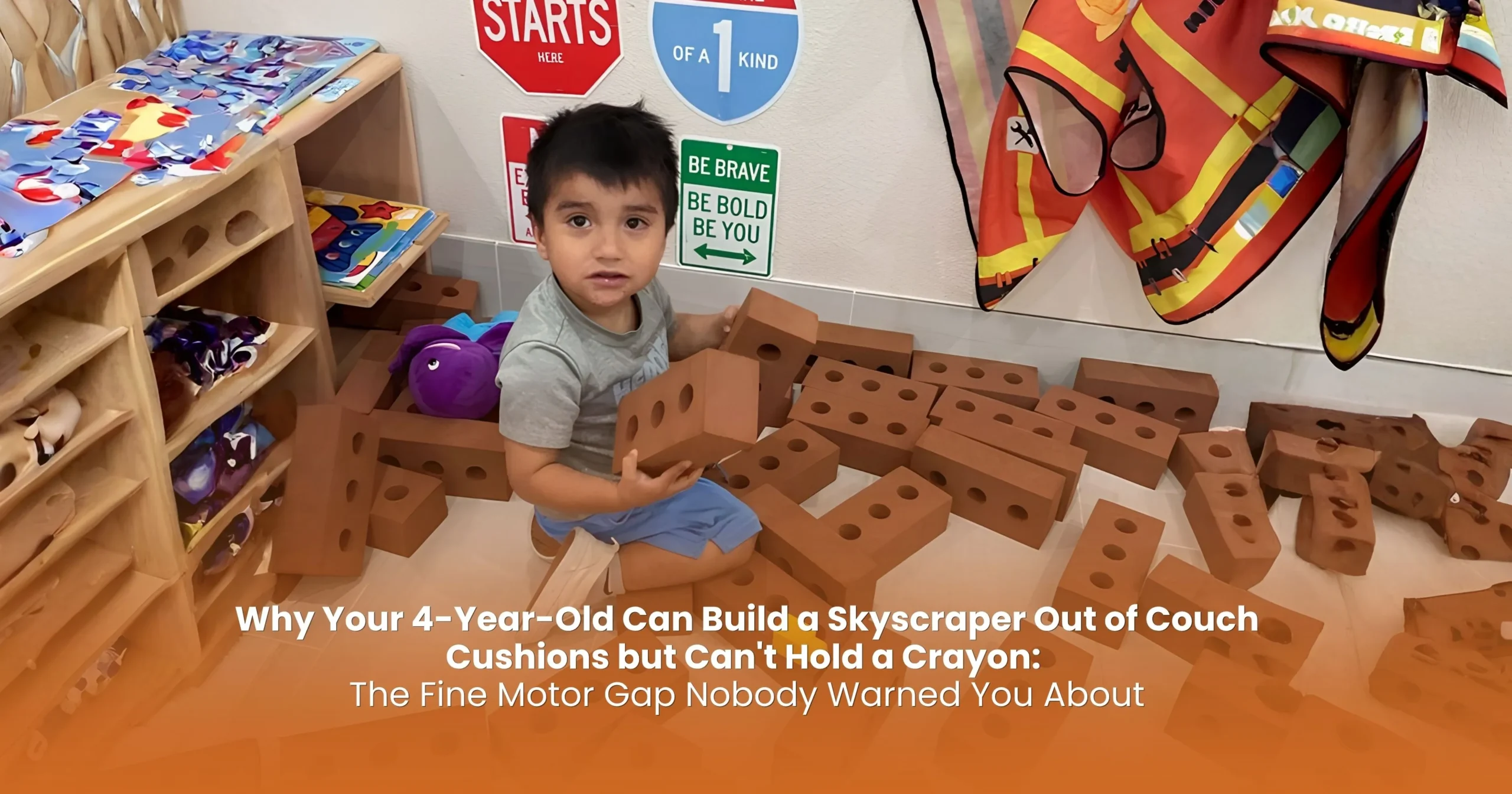
Your kid just built a five-foot fort out of couch cushions and held the whole thing together while balancing on one foot. They can climb the tallest play structure at the park. They can spin in circles for ten minutes without falling over.
Then you hand them a crayon and ask them to draw a circle. The grip is wrong. The lines wobble. They lose interest within twenty seconds.
This is one of the most common things we see at our preschool in Lewisville, and almost no parent has been told it is normal. It also happens to be one of the most predictable gaps in early childhood development, and it has a name. It is called the fine motor gap, and addressing fine motor skills in preschool is one of the highest-leverage things you can do as a parent of a 3 to 5 year old.
What Are Fine Motor Skills, Exactly?
Fine motor skills are the small, precise movements of the hands, fingers, and wrists. They are what your child uses to hold a pencil, button a shirt, manipulate small objects, use scissors, and eventually form letters on a page.
These skills develop separately from gross motor skills, which are the big-muscle movements involved in running, climbing, jumping, and balance. A child can be miles ahead on gross motor development and quietly behind on fine motor development. The gap will not show up until they are asked to do something specific with their hands, often for the first time in a structured preschool setting.
By age 4, most children are working on:
- A mature tripod or quadrupod pencil grip
- Drawing basic shapes (vertical line, horizontal line, circle, cross)
- Using child-safe scissors with reasonable control
- A pincer grasp strong enough to pick up small objects deliberately
- The hand strength to apply consistent pressure when drawing or writing
If any of those feel out of reach right now, your child is not behind. You are simply noticing the gap early, which is exactly the right time to notice it.
Why Are So Many Kids Hitting This Gap Right Now?
A few things have shifted in the last fifteen years that make fine motor development harder than it used to be:
- Screen time has replaced a lot of hand-led play. Tapping a screen does not build the same hand strength as squeezing playdough, stacking small blocks, or working with tongs. There is no resistance, no grip development, no bilateral coordination.
- Modern children’s clothing has fewer fine motor demands. Snap closures, velcro, and pull-up training pants have replaced buttons, zippers, and laces. Each is more convenient and slightly less developmental.
- Pre-cut food, sippy cups, and feeding pouches have reduced the everyday opportunities children once had to manipulate small objects with their hands.
- Earlier academic pressure has shifted preschool time toward letter recognition and reading prep, sometimes at the expense of the hands-on activities that build the underlying motor skills letters require.
None of this is anyone’s fault. It is the cumulative effect of small, reasonable choices that have rebalanced what a typical preschool day looks like. The children most affected are the ones whose daily life happens to involve less hand-led play.
What Does the Research Say About Fine Motor and Kindergarten Success?
Fine motor skill at preschool age is one of the strongest predictors of kindergarten and early elementary academic success.
What stands out in the data is that fine motor performance at age 4 predicts academic performance years later, even when researchers control for IQ, family income, and parent education. It is not because writing letters matters in itself. It is because the same neural systems that build fine motor control also support the focus, working memory, and visual-motor integration that classroom learning requires.
This is why occupational therapists and early childhood educators take pre-writing skills so seriously, and why a 4-year-old who is struggling with the crayon is showing you something the research takes seriously.
What Is the Normal Developmental Sequence for Fine Motor Skills?
Fine motor development unfolds in a roughly predictable order:
- Around 9 to 12 months: pincer grasp emerges (thumb and forefinger picking up small objects)
- 12 to 18 months: scribbling appears, palmar grasp on writing tools
- 2 to 3 years: imitating vertical and horizontal lines, beginning a digital pronate grasp on crayons
- 3 to 4 years: drawing circles, copying simple shapes, transitioning to a static tripod grip
- 4 to 5 years: a mature dynamic tripod grip, copying squares and crosses, drawing recognizable figures, beginning to write letters
- 5 to 6 years: refined pencil control, age-appropriate letter formation, scissor accuracy
If your child seems delayed by more than 6 to 12 months across several of these milestones, it is worth a conversation with their pediatrician or preschool teacher. Catch it at age 4 and the gap typically closes. Catch it at age 7 and the path forward becomes more complicated, often involving formal occupational therapy.
What Activities Actually Build Fine Motor Skills in Preschool?
The activities that work are simple, inexpensive, and were the default fifty years ago. They share one thing in common: they require the child’s hand to work against resistance or precision.
For preschoolers, the most effective fine motor builders include:
- Playdough, modeling clay, and kinetic sand. The squeezing, rolling, and pinching are the workout.
- Tongs, tweezers, and clothespins. Picking up small objects (pom-poms, dry pasta, beads) with kid-safe tongs builds pincer strength.
- Threading and lacing. Beads on a string, lacing cards, or stringing dry pasta.
- Stickers. Peeling and placing stickers is one of the most underrated pre-writing exercises there is.
- Cutting practice with child-safe scissors. Start with strips of paper, work up to straight lines, then to shapes.
- Tearing paper along a line. Strange but true. Tearing builds bilateral coordination and finger strength.
- Building with small construction toys. LEGO Duplo, Magna-Tiles, snap-block sets.
- Real-world fine motor tasks. Buttoning their own shirt. Zipping their coat. Pouring their own water from a small pitcher. The classic Montessori “practical life” tasks all qualify.
You will notice what is not on this list: tracing worksheets and tablet-based “learn to write” apps. Both have a place, but they do not build the underlying hand strength. They practice the final skill before the underlying capability exists.
When Should You Be Concerned About Fine Motor Delays?
Most fine motor gaps close with consistent preschool experience and the right kinds of play at home. A few signs that suggest a professional evaluation might be useful:
- Your child is consistently avoiding fine motor tasks (drawing, crayons, scissors) at age 4 or older
- They tire visibly after a few minutes of writing or drawing
- They cannot maintain a tripod pencil grip by age 5
- They have difficulty with basic self-care tasks like buttoning, zipping, or feeding themselves cleanly
- A teacher or pediatrician has expressed concern at more than one well-child visit
A pediatric occupational therapy evaluation is short, gentle, and often the difference between a child who struggles through early elementary school and one who walks into kindergarten with strong, ready hands.
How Milestones Academy Builds Fine Motor Skills Every Day
Fine motor skill development is woven into the daily rhythm of our preschool classrooms in Lewisville. Children work with playdough, scissors, tongs, beads, and small construction materials as a normal part of the day, not as an occasional activity. Our Early Pre-K and Pre-K programs build pre-writing readiness into the curriculum alongside reading, math, and social-emotional learning.
Our engineering and STEAM activities are designed in part to give children real, structured hand-led play, the kind that builds the hand strength and bilateral coordination that crayons, pencils, and scissors will later require.
A Final Word for Parents
The fine motor gap is one of the easiest developmental issues to spot and one of the easiest to address, but only if you know to look for it. The window is widest between ages 3 and 5, and the activities that close the gap are the same activities most children naturally enjoy when offered them.
If your 4-year-old can build a fort but cannot hold a crayon, that observation is the data telling you exactly what to focus on next. They are not behind. They are showing you where the next month of practice should live.
Want to see how fine motor readiness is built into a real preschool day?
Our teachers in Lewisville design every classroom to build hand strength, pincer grip, and pre-writing readiness alongside the rest of the early childhood curriculum.
Explore our Pre-K Program or book a tour to see it in action. Call us at (469) 962-6886.
Milestones Academy of Texas, serving families in Lewisville, Carrollton, and The Colony, Texas.
See Milestones Academy in Person
Visit our Lewisville campus, meet the educators, and ask the questions that matter to your family.